
Post Date : 07-2020
Edit ProfileIndustry
Consulting, Accounting, Finance-Banking
No. of Employees
100+
Primary Location
San Francisco Avenue, Lancaster, CA, USA
Website
https://www.google.com/
Jobs Posted
41 Jobs
JIM Mil
We are SDVI, a cutting-edge SaaS developer for Media & Entertainment, and we believe that the ideal company is a tight-knit team pursuing excellence and having fun along the way. We are a com
Project Management:
• Lead project scope development and options analysis and recommend technical solutions to meet customer needs (third party or in-house).
• Responsible for the creation of project plans, timelines, milestones, goals and ownership
• Must complete and implement projects on time, and ensure all assigned tasks and projects are executed to department quality standards.
• Plan, execute and report on the status of small to medium complex projects.
• Recognized as a technical lead for onshore and offshore teams on small and mid-sized projects.
• Other projects as assigned by the manager
Customer Experience:
• Work closely with mid to senior level management and project team during scope development and option analysis phase.
• Lead the technical aspects of the projects and/or solutions to meet client group expectations.
• Translate business requirements into technical/system requirements
• Execute technical solutions to department quality standards.
Analytics:
• Involved in research and analysis of third party software solutions, and must be able to make a recommendation to use third party software or develop solution in-house
• Identify future opportunities for application enhancement and value generation.
• Know how to break technical solutions into logical units, and have the ability to use models to show applications or program flow.
asdfasadfasdfasdfsadfa
asdfasdfasdfasdfsadfasdfsad
adsfasdfasdfasdfasdfasdfasdfasd
asdfasdfsadfsadfasdfasdfsadfa
JOB LIST
London, UK
Basic requirements:
- 7+ years of Microsoft software stack experience (preferred device data handling experience)
- Demonstrated experience working in an agile software development team
- Has shipped at least one commercially used software product
- An expert in the following areas: Device and IoT protocols, Bluetooth, C#, .Net, APIs, OData, WinForms, WPF, Unit testing/mocking frameworks
- Comfortable translating business requirements into a design
- Can lead majority of the teams cards by themselves
- Can handle an escalation (e.g. system outage) by themselves with rare exception
- Participates in product support (e.g. on call support)
- Has a decent approach between getting the job done vs creating technical debt
- Understands what agile development is, could teach the ideas
- Can explain and communicate technically complicated and abstract topics to business and product teams effectively
- Comfortable automating repeated tasks
- Hybrid working schedule(combination of remote and onsite)available following onboarding period
Agile Specific Requirements:
Cleveland, OH, USA
Enthalpy /??nθ?lpi/ ( listen) is a property of a thermodynamic system, defined as the sum of the system's internal energy and the product of its pressure and volume.[1][2] It is a convenient state function standardly used in many measurements in chemical, biological, and physical systems at a constant pressure. The pressure-volume term expresses the work required to establish the system's physical dimensions, i.e. to make room for it by displacing its surroundings.[3][4] As a state function, enthalpy depends only on the final configuration of internal energy, pressure, and volume, not on the path taken to achieve it.
The unit of measurement for enthalpy in the International System of Units (SI) is the joule. Other historical conventional units still in use include the British thermal unit (BTU) and the calorie.
The total enthalpy of a system cannot be measured directly because the internal energy contains components that are unknown, not easily accessible, or are not of interest in thermodynamics. In practice, a change in enthalpy (ΔH) is the preferred expression for measurements at constant pressure, because it simplifies the description of energy transfer. When matter transfer into or out of the system is also prevented, the enthalpy change equals the energy exchanged with the environment by heat. Calibration of enthalpy changes requires a reference point. Enthalpies for chemical substances at constant pressure usually refer to standard state: most commonly 1 bar (100 kPa) pressure. Standard state does not strictly specify a temperature, but expressions for enthalpy generally reference the standard heat of formation at 25 °C (298 K). For endothermic (heat-absorbing) processes, the change ΔH is a positive value; for exothermic (heat-releasing) processes it is negative.
The enthalpy of an ideal gas is independent of its pressure, and depends only on its temperature, which correlates to its internal energy. Real gases at common temperatures and pressures often closely approximate this behavior, which simplifies practical thermodynamic design and analysis.
Rajkot, Gujarat, India
Bhargav Test - 4 Dec
Bhargav Test - 4 Dec
Bhargav Test - 4 Dec
Bhargav Test - 4 Dec
Bhargav Test - 4 Dec
Nova, OH, USA
We are looking for an experienced marketing leader to serve as the Director of Consumer Product Marketing for Instagram overseeing our Community Pillar. This individual will lead Instagram’s consumer marketing efforts related to Well-being, Equity, Foundations, and Growth. They will lead a team to develop breakthrough marketing initiatives that connect Instagram's consumer audiences to our products, while also thinking holistically about the growth and health of our entire Instagram community.
The ideal candidate will be a visionary leader who can drive both strategy and execution and cares deeply about Instagram's mission to strengthen relationships through shared experiences. They have a passion for enabling and maintaining healthy online communities that are safe and equitable. They are analytical and creative, highly collaborative, and will have a successful track record of launching & scaling mass-market consumer products or services that people cannot live without for a range of consumer power brands. A successful candidate will be a teacher and communicator, having extensive experience in people management, coaching and mentoring.
- Lead a high-performing team of product marketers and all aspects of consumer product marketing for the Instagram Community Pillar
- Support and scale a world-class marketing team by investing in and hiring excellent people, and supporting them with the resources and infrastructure to scale
- Work with Research & Analytics to generate quantitative, qualitative, and competitive insights to influence strategy and inform product roadmap, product positioning and go-to-market plans to ensure we're building products and features that add the most possible value to the consumer while protecting our community
- Lead the team in creating and driving effective go-to-market plans working closely with cross-functional teams to determine effective launch strategy and communications sequencing
- Partner with brand and integrated marketing on outbound marketing and advertising strategies and programs to drive consumer awareness, adoption and long term engagement
- Understand and effectively advocate for specific needs and sensitivities of underrepresented consumers in both developed and emerging markets around the world
- Tackle complex challenges with a strategic mindset and create thoughtful recommendations and action plans for solving them with product and cross-functional leadership
- 10 or more years of experience with team leadership, cross-functional team leadership, leadership, or team management
- 15+ years of experience launching & scaling consumer apps, products or services for a range of global consumer brands
- Experience developing and driving analytically rigorous online and offline marketing campaigns
- Experience motivating and challenging teams and individuals at all levels of an organization, both directly and cross-functionally
- Experience working on issues related to integrity, civic engagement, equity, and/or mental health
- Depth of expertise in growing consumer businesses through sustained engagement and acquisition
- International experience and knowledge of diverse cultural, social and business landscapes
- Understanding of digital and mobile video and the entertainment and technology landscape both in the U.S. and internationally
Dayton, OH, USA| Cleveland, OH, USA| Northampton, UK
Enthalpy /??nθ?lpi/ (listen) is a property of a thermodynamic system, defined as the sum of the system's internal energy and the product of its pressure and volume.[1][2] It is a convenient state function standardly used in many measurements in chemical, biological, and physical systems at a constant pressure. The pressure-volume term expresses the work required to establish the system's physical dimensions, i.e. to make room for it by displacing its surroundings.[3][4] As a state function, enthalpy depends only on the final configuration of internal energy, pressure, and volume, not on the path taken to achieve it.
The unit of measurement for enthalpy in the International System of Units (SI) is the joule. Other historical conventional units still in use include the British thermal unit (BTU) and the calorie.
The total enthalpy of a system cannot be measured directly because the internal energy contains components that are unknown, not easily accessible, or are not of interest in thermodynamics. In practice, a change in enthalpy (ΔH) is the preferred expression for measurements at constant pressure, because it simplifies the description of energy transfer. When matter transfer into or out of the system is also prevented, the enthalpy change equals the energy exchanged with the environment by heat. Calibration of enthalpy changes requires a reference point. Enthalpies for chemical substances at constant pressure usually refer to standard state: most commonly 1 bar (100 kPa) pressure. Standard state does not strictly specify a temperature, but expressions for enthalpy generally reference the standard heat of formation at 25 °C (298 K). For endothermic (heat-absorbing) processes, the change ΔH is a positive value; for exothermic (heat-releasing) processes it is negative.
The enthalpy of an ideal gas is independent of its pressure, and depends only on its temperature, which correlates to its internal energy. Real gases at common temperatures and pressures often closely approximate this behavior, which simplifies practical thermodynamic design and analysis.
New York, NY, USA| Delhi, India
Carbon-14 (14C), or radiocarbon, is a radioactive isotope of carbon with an atomic nucleus containing 6 protons and 8 neutrons. Its presence in organic materials is the basis of the radiocarbon dating method pioneered by Willard Libby and colleagues (1949) to date archaeological, geological and hydrogeological samples. Carbon-14 was discovered on February 27, 1940, by Martin Kamen and Sam Ruben at the University of California Radiation Laboratory in Berkeley, California. Its existence had been suggested by Franz Kurie in 1934.[2]There are three naturally occurring isotopes of carbon on Earth: carbon-12, which makes up 99% of all carbon on Earth; carbon-13, which makes up 1%; and carbon-14, which occurs in trace amounts, making up about 1 or 1.5 atoms per 1012 atoms of carbon in the atmosphere. Carbon-12 and carbon-13 are both stable, while carbon-14 is unstable and has a half-life of 5,730 ± 40 years.[3] Carbon-14 decays into nitrogen-14 through beta decay.[4] A gram of carbon containing 1 atom of carbon-14 per 1012 atoms will emit ~0.2[5] beta particles per second. The primary natural source of carbon-14 on Earth is cosmic ray action on nitrogen in the atmosphere, and it is therefore a cosmogenic nuclide. However, open-air nuclear testing between 1955 and 1980 contributed to this pool.The different isotopes of carbon do not differ appreciably in their chemical properties. This resemblance is used in chemical and biological research, in a technique called carbon labeling: carbon-14 atoms can be used to replace nonradioactive carbon, in order to trace chemical and biochemical reactions involving carbon atoms from any given organic compound.
parma, ohio
2. Previous Human CoV EpidemicsUsually, infections caused by theBetacoronavirusesare mild to asymptomatic [19,20]. Since thefirst report of CoV in the 1960s, humans have been affected by CoV infection. To date, six strains ofCoVs, causing mild to severe respiratory illnesses in humans, have been identified [21]. Of these, fourCoVs (HCoV-NL63, HCoV-229E, HCoV-OC43, and HCoV-HKU1) cause mild symptoms in humans.Contrarily, two highly pathogenic CoVs caused outbreaks of severe respiratory illness due to zoonotictransmission in humans, namely the severe acute respiratory syndrome (SARS) and MERS.2.1. SARS-CoVThe first incidence of SARS-CoV infection was reported on 16 November 2002, in the coastalGuangdong province of southeast China bordering Hong Kong and Macau. This infection spreadacross 31 countries at a moderate speed. The virus was predicted to originate from bats and civet catswith animal-to-human (zoonotic) and human-to-human modes of transmission, as shown in Table 1.A winter season predilection was also noted in the pattern of this epidemic. After adopting strictpublic health measures, consisting of quarantine and the lockdown of air traffic, the disease was finallycontained by 5 July 2003 [22]. During this period, SARS-CoV infected 8422 humans and caused 916deaths at a CFR of 10.87%. Since then, SARS has phased out, and the outbreak was managed.2.2. MERS-CoVSince the first occurrence of MERS in Saudi Arabia in June 2012, sporadic cases are still reported,primarily in the Arabian Peninsular region, and MERS has spread to more than 27 countries worldwide.Notably, the CFR in MERS is the highest (34.77%) among all CoVs. To date, it has infected 2496 humanswith the deaths of 868 patients. The disease was reported in Saudi Arabia, the UAE and the Republicof Korea, as shown in Table 1. A few travel-related cases have been reported in Europe in individualswith a travel history to the Arabian Peninsular countries. The source of viral origin was traced tobats, and camels were the intermediate hosts for the virus, which followed animal-to-human (zoonoticdisease) and human-to-human modes of virus transmission [19,23].2.3. SARS-CoV-2The first case of SARS-CoV-2 infection was reported in the first week of December 2019 in WuhanCity, Hubei Province, China. Using deep sequencing methods, the causative agent for this deadlypandemic was identified as a new member of theBetacoronavirusgenus [24,25]. The newly identifiedCoV had an 82% sequence identity with the human SARS-CoV [26]. It was initially designated as2019-novel coronavirus (2019-nCoV). Later, the International Committee on Taxonomy of Virusesofficially named it as the severe acute respiratory syndrome coronavirus-2 (SARS-CoV-2), owing to itssignificant genetic relatedness to SARS-CoV. Subsequently, the WHO named the disease caused bySARS-CoV-2 as coronavirus disease-2019 (COVID-19) on 11 February 2020, as shown in Figure 1
Northampton, UK| Nova, Ohio, USA| Los Angeles, CA, USA
Mumbai (formerly called Bombay) is a densely populated city on India’s west coast. A financial center, it's India's largest city. On the Mumbai Harbour waterfront stands the iconic Gateway of India stone arch, built by the British Raj in 1924. Offshore, nearby Elephanta Island holds ancient cave temples dedicated to the Hindu god Shiva. The city's also famous as the heart of the Bollywood film industry. ? Google
Cleveland, OH, USA
Basic requirements:
- 7+ years of Microsoft software stack experience (preferred device data handling experience)
- Demonstrated experience working in an agile software development team
- Has shipped at least one commercially used software product
- An expert in the following areas: Device and IoT protocols, Bluetooth, C#, .Net, APIs, OData, WinForms, WPF, Unit testing/mocking frameworks
- Comfortable translating business requirements into a design
- Can lead majority of the teams cards by themselves
- Can handle an escalation (e.g. system outage) by themselves with rare exception
- Participates in product support (e.g. on call support)
- Has a decent approach between getting the job done vs creating technical debt
- Understands what agile development is, could teach the ideas
- Can explain and communicate technically complicated and abstract topics to business and product teams effectively
- Comfortable automating repeated tasks
- Hybrid working schedule(combination of remote and onsite)available following onboarding period
Agile Specific Requirements:
San Francisco Avenue, Lancaster, CA, USA
Click to view map
Postcode Ward Northing
E1 6AN Bishopsgate 181747
E1 7AA Portsoken 181382
E1 7AD Portsoken 181368
E1 7AE Portsoken 181385
65 more rows
Postcodes in City of London - doogal.co.uk
www.doogal.co.uk › AdministrativeAreas
Feedback
About featured snippets
All Zip Codes in London WV - Zip-Codes.com
www.zip-codes.com › city › wv-london
City of London, WV - KANAWHA County West Virginia ZIP Codes. Detailed information on every zip code in London.
Postcode London | postal-code.co.uk
postal-code.co.uk › postcode › London
Lookup Postcode - Zip Code - Postal Code of address in London on map. Find postcode by address or by point doing click on map. Drag to change point.
Cambridge, UK
In other words, maximum efficiency is achieved if and only if no new entropy is created in the cycle, which would be the case if e.g. friction leads to dissipation of work into heat. In that case, the cycle is not reversible and the Clausius theorem becomes an inequality rather than an equality. Otherwise, since entropy is a state function, the required dumping of heat into the environment to dispose of excess entropy leads to a (minimal) reduction in efficiency. So Equation 3 gives the efficiency of any reversible heat engine.
In mesoscopic heat engines, work per cycle of operation in general fluctuates due to thermal noise. If the cycle is performed quasi-statically, the fluctuations vanish even on the mesoscale.[4] However, if the cycle is performed faster than the relaxation time of the working medium, the fluctuations of work are inevitable. Nevertheless, when work and heat fluctuations are counted, there is exact equality that relates the exponential average of work performed by any heat engine and the heat transfer from the hotter heat bath.[5]
New York, NY, USA
You have an understanding of the drivers behind market moving stories and events. You're a solution-finder, with a real passion for providing exceptional customer service in a fast-paced environment. With a desire to build a career in a client-facing role, you understand the importance of credibility and building relationships!
Join our comprehensive Analytics & Sales summer internship program, where you will rotate between both departments over the course of ten weeks, gaining an insight into what our graduate role has to offer!
What is the role?
You will start with a week of classroom based financial product and functionality training, to broaden your knowledge of the global financial markets and our market leading Bloomberg solutions. After your training, you'll join a team where you'll immediately begin collaborating with interns on Analytics and Sales projects.
You'll have the opportunity to interact with clients, making valuable contributions by taking part in sales campaigns, promoting product features and prospecting for new business. Hands-on individual and group projects will allow you to experience how your full-time career could evolve.
To round out your experience, you'll attend lunch and learn sessions, designed to teach you about our diversified group, and there will be plenty of opportunities to meet Bloomberg leaders at a variety of networking events. Of course we also want to give you the chance to get to know your peers, so you'll also take part in volunteering activities and social events with interns from other departments.
Analytics
We provide 24/7 support for Bloomberg Professional Service users all over the world and across multiple industries. Reaching us via our 'Instant Bloomberg' chat system, clients access unparalleled customer service where we answer their questions and help them maximize the value of Bloomberg's products. On any given day we respond to over 12,000 queries in more than 15 languages. From educating a portfolio manager on Bloomberg's risk management solutions to helping a trader use our functionality to discover new sources of market liquidity - the variety of problems we solve is immense.
Bloomberg is constantly innovating and Analytics plays a key role in ensuring clients are educated on new products and enhancements by proactively working closely to upskill them through technology, and delivering on-site training and seminars. We also work in conjunction with Enterprise Sales to deliver on strategic initiatives, supporting product roll-out and onboarding clients. We want to ensure our clients are making the most of our service and using tools and features that allow them to work smarter.
Sales
In Sales, we're the face of Bloomberg for our clients. Consultative and entrepreneurial, we manage client relationships, whilst striving to continually grow our revenue by identifying new business opportunities.
We spend our time with our clients, understanding their business goals and outpacing their expectations. Guided by curiosity and purpose, we work to understand their workflows and present them with the most appropriate solutions across our range of enterprise offerings.
We're discovering new business leads by making prospecting calls and networking. We demonstrate how Bloomberg's product offering will help our clients make the best investment/trading/business decisions, making their day to day business smoother and more profitable.
You need to have:
- Strong critical-thinking and problem-solving skills
- A demonstrated interest in the financial markets and the aspiration to work in the financial services industry
- The resilience to learn and adapt quickly in a dynamic environment
- Real ambition to pursue a client-facing career, with a strong interest in relationship management and sales
- Outstanding communication skills (both written and verbal)
- Availability for the full 10-week duration of the internship from June 4th - August 13th 2021
- The ability to start in a full-time role in 2022
We'd love to see:
- Work experience in a client facing role
- Interest in technology
Apply if you think we're a good match. We'll get in touch to let you know what the next steps are! Please note this is a two stage application process, following the submission of your candidate details you will receive an email with directions to complete an online assessment. Your application will not be complete until you have submitted the assessment.
We are an equal opportunity employer and value diversity at our company. We do not discriminate on the basis of race, religion, color, national origin, gender, sexual orientation, age, marital status, veteran status, or disability status.
NYC, NY, USA
Cloud hosting plans look much like virtual private server (VPS) web hosting products, where you'll initially pay for a set amount of web space, RAM, CPU time and bandwidth. But these resources are spread across multiple devices instead of just one, and changing your plan later – adding another gig of RAM, for instance – is generally as easy as dragging a slider, with the extra power coming online within moments.There are also additional options for small business web hosting, such as environmentally-friendly green web hosting. Additionally, cloud hosting is scalable and can provide for a good alternative to needing a dedicated server with colocation provider, and there are options for managed web hosting services.You can use cloud hosting for everything, from just hosting your emails, to replacing your business server. However, if you want a hands-on experience expect the virtual servers to be running Linux, not Windows.Cloud hosting still won't be for everyone, and small, simple websites are likely to be better off with regular packages. But the technology has a lot to offer anyone with larger or more ambitious projects, and many hosts run free trials which make it easy to explore their abilities for yourself.
California, USA
Project Management:
• Lead project scope development and options analysis and recommend technical solutions to meet customer needs (third party or in-house).
• Responsible for the creation of project plans, timelines, milestones, goals and ownership
• Must complete and implement projects on time, and ensure all assigned tasks and projects are executed to department quality standards.
• Plan, execute and report on the status of small to medium complex projects.
• Recognized as a technical lead for onshore and offshore teams on small and mid-sized projects.
• Other projects as assigned by the manager
Customer Experience:
• Work closely with mid to senior level management and project team during scope development and option analysis phase.
• Lead the technical aspects of the projects and/or solutions to meet client group expectations.
• Translate business requirements into technical/system requirements
• Execute technical solutions to department quality standards.
Analytics:
• Involved in research and analysis of third party software solutions, and must be able to make a recommendation to use third party software or develop solution in-house
• Identify future opportunities for application enhancement and value generation.
• Know how to break technical solutions into logical units, and have the ability to use models to show applications or program flow.
Northampton, UK
In other words, maximum efficiency is achieved if and only if no new entropy is created in the cycle, which would be the case if e.g. friction leads to dissipation of work into heat. In that case, the cycle is not reversible and the Clausius theorem becomes an inequality rather than an equality. Otherwise, since entropy is a state function, the required dumping of heat into the environment to dispose of excess entropy leads to a (minimal) reduction in efficiency. So Equation 3 gives the efficiency of any reversible heat engine.
In mesoscopic heat engines, work per cycle of operation in general fluctuates due to thermal noise. If the cycle is performed quasi-statically, the fluctuations vanish even on the mesoscale.[4] However, if the cycle is performed faster than the relaxation time of the working medium, the fluctuations of work are inevitable. Nevertheless, when work and heat fluctuations are counted, there is exact equality that relates the exponential average of work performed by any heat engine and the heat transfer from the hotter heat bath.[5]

San Francisco Avenue, Lancaster, CA, USA
Mumbai (formerly called Bombay) is a densely populated city on India’s west coast. A financial center, it's India's largest city. On the Mumbai Harbour waterfront stands the iconic Gateway of India stone arch, built by the British Raj in 1924. Offshore, nearby Elephanta Island holds ancient cave temples dedicated to the Hindu god Shiva. The city's also famous as the heart of the Bollywood film industry. ? Google
Delhi, India
Basic requirements:
- 7+ years of Microsoft software stack experience (preferred device data handling experience)
- Demonstrated experience working in an agile software development team
- Has shipped at least one commercially used software product
- An expert in the following areas: Device and IoT protocols, Bluetooth, C#, .Net, APIs, OData, WinForms, WPF, Unit testing/mocking frameworks
- Comfortable translating business requirements into a design
- Can lead majority of the teams cards by themselves
- Can handle an escalation (e.g. system outage) by themselves with rare exception
- Participates in product support (e.g. on call support)
- Has a decent approach between getting the job done vs creating technical debt
- Understands what agile development is, could teach the ideas
- Can explain and communicate technically complicated and abstract topics to business and product teams effectively
- Comfortable automating repeated tasks
- Hybrid working schedule(combination of remote and onsite)available following onboarding period
Agile Specific Requirements:
Dayton, OH, USA| Cleveland, OH, USA
Enthalpy /??nθ?lpi/ (listen) is a property of a thermodynamic system, defined as the sum of the system's internal energy and the product of its pressure and volume.[1][2] It is a convenient state function standardly used in many measurements in chemical, biological, and physical systems at a constant pressure. The pressure-volume term expresses the work required to establish the system's physical dimensions, i.e. to make room for it by displacing its surroundings.[3][4] As a state function, enthalpy depends only on the final configuration of internal energy, pressure, and volume, not on the path taken to achieve it.
The unit of measurement for enthalpy in the International System of Units (SI) is the joule. Other historical conventional units still in use include the British thermal unit (BTU) and the calorie.
The total enthalpy of a system cannot be measured directly because the internal energy contains components that are unknown, not easily accessible, or are not of interest in thermodynamics. In practice, a change in enthalpy (ΔH) is the preferred expression for measurements at constant pressure, because it simplifies the description of energy transfer. When matter transfer into or out of the system is also prevented, the enthalpy change equals the energy exchanged with the environment by heat. Calibration of enthalpy changes requires a reference point. Enthalpies for chemical substances at constant pressure usually refer to standard state: most commonly 1 bar (100 kPa) pressure. Standard state does not strictly specify a temperature, but expressions for enthalpy generally reference the standard heat of formation at 25 °C (298 K). For endothermic (heat-absorbing) processes, the change ΔH is a positive value; for exothermic (heat-releasing) processes it is negative.
The enthalpy of an ideal gas is independent of its pressure, and depends only on its temperature, which correlates to its internal energy. Real gases at common temperatures and pressures often closely approximate this behavior, which simplifies practical thermodynamic design and analysis.
Tankara, Gujarat, India
tankara job tankara job tankara job tankara job tankara job tankara job tankara job tankara job tankara job tankara job tankara job tankara job tankara job tankara job tankara job tankara job tankara job tankara job tankara job tankara job tankara job tankara job tankara job tankara job tankara job tankara job tankara job tankara job tankara job tankara job tankara job tankara job tankara job tankara job tankara job tankara job tankara job tankara job tankara job
Nova, OH, USA| Chicago, IL, USA
Our integrated FileMaker system, consisting of over 100 or more files and thousands of related tables is extremely advanced and ambitious. We use it to manage many aspects of our operation. Furthermore, we are constantly multiplying the innovative ways in which we use it. For that reason, we have made a long-term investment (for over 20 years) in maintaining a permanent in-house FileMaker team, which we want to expand.
Therefore, this position offers the prospect of a career and, as we are a labor union, an excellent benefit package.
The team currently works remotely from home due to the COVID situation. When things return to normal, we intend to be flexible about remote work, and will consider skilled applicants who don’t live in the New York area.
Benefits include: Medical, Dental, Optical, and Prescription Drugs with family coverage (including domestic partners); Pension, Pre-paid Legal, Flexible Spending Accounts, Life Cycle Benefits, Long-Term Care Insurance, and other benefits.
Requirements:
- At least 5 years building and maintaining business applications using the FileMaker platform
- Advanced command of scripting, layout design, custom functions, privilege sets and relationship graph organization
- Command of the Mac OS X environment
Other useful experience/qualifications:
- Working with web services in FileMaker (JSON/XML)
- UI/UX design
- AppleScript
- Networking skills
- Python
- JavaScript
How to Apply:
Please click 'Apply Now' below to submit a resume, three references and a cover letter with the subject line “FileMaker Pro Developer.” The cover letter should be clear and concise and explain the specific reasons for your interest in the position, and specify (with appropriate explanation) which of each of the listed qualifications you possess and which ones you do not possess.
The New York Hotel Trades Council, AFL-CIO, is an equal opportunity employer. All persons regardless of age, race, ethnicity, gender, religious affiliation and sexual orientation are encouraged to apply.
Manchester, UK
In other words, maximum efficiency is achieved if and only if no new entropy is created in the cycle, which would be the case if e.g. friction leads to dissipation of work into heat. In that case, the cycle is not reversible and the Clausius theorem becomes an inequality rather than an equality. Otherwise, since entropy is a state function, the required dumping of heat into the environment to dispose of excess entropy leads to a (minimal) reduction in efficiency. So Equation 3 gives the efficiency of any reversible heat engine.
In mesoscopic heat engines, work per cycle of operation in general fluctuates due to thermal noise. If the cycle is performed quasi-statically, the fluctuations vanish even on the mesoscale.[4] However, if the cycle is performed faster than the relaxation time of the working medium, the fluctuations of work are inevitable. Nevertheless, when work and heat fluctuations are counted, there is exact equality that relates the exponential average of work performed by any heat engine and the heat transfer from the hotter heat bath.[5]
NYC, NY, USA| Boston, MA, USA
The following material is published, released, or pending publication, on the Independent Core Observer Model (ICOM) Research Project or references ICOM-related research. If you have questions or would like a copy of any of the published material below please feel free to contact us.
Kelley, A.; Twyman, M.; “Approaching the Psychology of Artificial Intelligence;” Elsevier/Procedia Computer Science; Seattle, WA; Proceeding of BICA Society Conference 2020 JVTR; [PENDING]
Atreides, K.; Kelley, D.; Uplift; “Methodologies and Milestones for the Development of an Ethical Seed;” Proceeding of BICA Society Conference 2020 JVRT; AGI Laboratory; [PENDING]
Dambrot, S.; “Theoretical and hypothetical pathways to real-time neuromorphic AGI/post-AGI ecosystems;“, Procedia Computer Science, Volume 169, 2020, Pages 100-122; https://www.sciencedirect.com/science/article/pii/S1877050920302453
Akron, OH, USA| Chicago, IL, USA
The simplest case of a normal distribution is known as the standard normal distribution. This is a special case when μ = 0 {\displaystyle \mu =0} 

φ ( x ) = 1 2 π e − 1 2 x 2 {\displaystyle \varphi (x)={\frac {1}{\sqrt {2\pi }}}e^{-{\frac {1}{2}}x^{2}}}
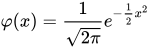
Here, the factor 1 / 2 π {\displaystyle 1/{\sqrt {2\pi }}} 


Authors differ on which normal distribution should be called the "standard" one. Carl Friedrich Gauss, for example, defined the standard normal as having a variance of σ 2 = 1 / 2 {\displaystyle \sigma ^{2}=1/2} 
φ ( x ) = e − x 2 π {\displaystyle \varphi (x)={\frac {e^{-x^{2}}}{\sqrt {\pi }}}}
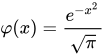
On the other hand, Stephen Stigler[7] goes even further, defining the standard normal as having a variance of σ 2 = 1 / ( 2 π ) {\displaystyle \sigma ^{2}=1/(2\pi )} 
φ ( x ) = e − π x 2 {\displaystyle \varphi (x)=e^{-\pi x^{2}}}
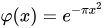
General normal distribution
Every normal distribution is a version of the standard normal distribution, whose domain has been stretched by a factor σ {\displaystyle \sigma } 

f ( x ? μ , σ 2 ) = 1 σ φ ( x − μ σ ) {\displaystyle f(x\mid \mu ,\sigma ^{2})={\frac {1}{\sigma }}\varphi \left({\frac {x-\mu }{\sigma }}\right)}
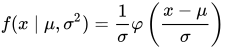
The probability density must be scaled by 1 / σ {\displaystyle 1/\sigma } 
If Z {\displaystyle Z} 



San Francisco, CA, USA| Chicago, IL, USA
Major Responsibilities:
Technology:
• Responsible for designing, developing, and implementing complex software systems
• Assist in the architectural design of applications for supported user departments.
• Assist and in some cases lead technical sessions at the departmental level and play a major role in mentoring junior developers
• Work with Senior Engineers and cross functional teams to analyze system and application issues for the supported applications.
• Must be fully fluent in multiple programming languages.
• Should have the ability to break large systems/programs into logical units.
• Identify opportunities to keep current on emerging technologies and their innovative usage as it pertains to departmental goals.
• Ensure development standards are followed for supported user applications. Suggest improvements, additions to standards.
• Be a part of the team that conducts new-hire interviews.
Project Management:
• Lead project scope development and options analysis and recommend technical solutions to meet customer needs (third party or in-house).
• Responsible for the creation of project plans, timelines, milestones, goals and ownership
• Must complete and implement projects on time, and ensure all assigned tasks and projects are executed to department quality standards.
• Plan, execute and report on the status of small to medium complex projects.
• Recognized as a technical lead for onshore and offshore teams on small and mid-sized projects.
• Other projects as assigned by the manager
San Francisco, CA, USA
As a member of our Software Engineering Group we look first and foremost for people who are passionate around solving business problems through innovation& engineering practices. You will be required to apply your depth of knowledge and expertise to all aspects of the software development lifecycle, as well as partner continuously with your many stakeholders on a daily basis to stay focused on common goals. We embrace a culture of experimentation and constantly strive for improvement and learning. You'll work in a collaborative, trusting, thought-provoking environment-one that encourages diversity of thought and creative solutions that are in the best interests of our customers globally.
This exciting role is part of JPMorgan's Index Research Technology team and will participate in the software engineering of a highly effective calculation engine with J2EE technology for Emerging Market and Credit business. You will be a key team member in application design, development and support for all internal/external clients. You will work heavily with Java/J2EE technology, Object Oriented Programming, Database, and Client/Server infrastructure development.
This role requires a wide variety of strengths and capabilities, including:
* Core Java and J2EE experience
* Spring framework, HTML5/React JS and MVC design/development
* Excellent Sybase and Database design, SQL
* Object-oriented design and coding practices / Design Patterns
* Agile work experience on application development in financial institutions
* Perl/Unix scripting experience
* M.S degree in Computer Science or Mathematics preferred
* Excellent problem solving / investigation abilities.
* Excellent communication skills.
* Good project and time-management skills
* Experience on Scala/SPARK/HBASE/Parquet/Kafka/Big Data is a plus
Our Corporate & Investment Bank relies on innovators like you to build and maintain the technology that helps us safely service the world's important corporations, governments and institutions. You'll develop solutions for a bank entrusted with holding $18 trillion of assets and $393 billion in deposits. CIB provides strategic advice, raises capital, manages risk, and extends liquidity in markets spanning over 100 countries around the world.
When you work at JPMorgan Chase & Co., you're not just working at a global financial institution. You're an integral part of one of the world's biggest tech companies. In 20 technology centers worldwide, our team of 50,000 technologists design, build and deploy everything from enterprise technology initiatives to big data and mobile solutions, as well as innovations in electronic payments, cybersecurity, machine learning, and cloud development. Our $10B+ annual investment in technology enables us to hire people to create innovative solutions that will are transforming the financial services industry.
At JPMorgan Chase & Co. we value the unique skills of every employee, and we're building a technology organization that thrives on diversity. We encourage professional growth and career development, and offer competitive benefits and compensation. If you're looking to build your career as part of a global technology team tackling big challenges that impact the lives of people and companies all around the world, we want to meet you.JPMorgan Chase & Co., one of the oldest financial institutions, offers innovative financial solutions to millions of consumers, small businesses and many of the world's most prominent corporate, institutional and government clients under the J.P. Morgan and Chase brands. Our history spans over 200 years and today we are a leader in investment banking, consumer and small business banking, commercial banking, financial transaction processing and asset management.
NYC, NY, USA
Project Management:
• Lead project scope development and options analysis and recommend technical solutions to meet customer needs (third party or in-house).
• Responsible for the creation of project plans, timelines, milestones, goals and ownership
• Must complete and implement projects on time, and ensure all assigned tasks and projects are executed to department quality standards.
• Plan, execute and report on the status of small to medium complex projects.
• Recognized as a technical lead for onshore and offshore teams on small and mid-sized projects.
• Other projects as assigned by the manager
Customer Experience:
• Work closely with mid to senior level management and project team during scope development and option analysis phase.
• Lead the technical aspects of the projects and/or solutions to meet client group expectations.
• Translate business requirements into technical/system requirements
• Execute technical solutions to department quality standards.
Toledo, OH, USA
Required Qualifications:
- Python (scripting, numpy, scipy, matplotlib, scikit-learn, jupyter notebooks)
- Experience with machine learning algorithms, such as neural networks/deep learning, SVM, XGBoost, Random Forest, generalized linear models, etc.
- Understanding of Sports Wagering Markets
- Experience with Amazon Web Services (EC2, S3, SageMaker, CodeCommit)
- Experience with MongoDB or similar NoSQL database
Desired Qualifications:
- Sports Analytics
- Experience with Database Management
- Experience moving research into production - serving models, hosting on cloud resources, automation, etc.
- Background in Game Theory, Control Theory
- Tensorflow or equivalent deep learning framework such asPyTorch, Caffe(2), MXNet
- Experience with ensemble methods
Job Description:
- Investigate, identify, develop and optimize new methods, algorithms and technologies to derive novel, competitive insights from disparate data sources.
- Collaborate with other data scientists and developers to identify, design, build and maintain tools, analytical workflows and applications to streamline and strengthen current processes.
- Applying new and emerging analytical methods and visualization technologies on real world data for the purposes of building investment strategies around the outcomes of sporting events.
To Apply
Cincinnati, OH, USA
Cincinnati is a city in Ohio, on the Ohio River. The Over-the-Rhine district is known for its 19th-century architecture, including Findlay Market, which has food and craft vendors. To the north is the Cincinnati Zoo & Botanical Garden. The Cincinnati Museum Center encompasses history, science and children's museums in the art deco Union Terminal. Works spanning 6,000 years are on display at the Cincinnati Art Museum. ? Google
NYC, NY, USA| Salem, MA, USA| San Francisco, CA, USA
Project Management:
• Lead project scope development and options analysis and recommend technical solutions to meet customer needs (third party or in-house).
• Responsible for the creation of project plans, timelines, milestones, goals and ownership
• Must complete and implement projects on time, and ensure all assigned tasks and projects are executed to department quality standards.
• Plan, execute and report on the status of small to medium complex projects.
• Recognized as a technical lead for onshore and offshore teams on small and mid-sized projects.
• Other projects as assigned by the manager
Customer Experience:
• Work closely with mid to senior level management and project team during scope development and option analysis phase.
• Lead the technical aspects of the projects and/or solutions to meet client group expectations.
• Translate business requirements into technical/system requirements
• Execute technical solutions to department quality standards.
Analytics:
• Involved in research and analysis of third party software solutions, and must be able to make a recommendation to use third party software or develop solution in-house
• Identify future opportunities for application enhancement and value generation.
• Know how to break technical solutions into logical units, and have the ability to use models to show applications or program flow.
NYC, NY, USA| Chicago, IL, USA
Roles and Responsibilities
- Source and screen potential IT candidates for contract, contract-to-hire, and permanent openings
- Fully understand the needs of your respective hiring managers and collaborate with them to lead the full lifecycle recruitment process for mid-to-senior level hires
- Review the pipeline of potential candidates in our Applicant Tracking System (ATS), match applicants with job requirements based on candidate work history, skills, education, training, and other qualifications
- Source candidates directly through both internal and external industry networking events and various online recruiting tools
- Manage and review resumes, schedule, interview, negotiate offers/close candidates, transition candidates to the onboarding team
- Provide continuous feedback to candidates, hiring managers, and other stakeholders
- Establish relationships with consultants/contractors in a specified region or with clients
- Drive our brand through social media, industry conferences and open-house events
- Partner with academic and diversity organizations to improve and enhance our recruitment strategy in addition to building a diverse pipeline of candidates through direct sourcing activities
- Meet or exceed weekly performance goals and expectations
- Build effective recruiting strategies to attract qualified talent and be able to benchmark success.
Experience/Skills:
- 5+ years of recent recruiting experience, including successful recruitment of experienced IT professionals
- Exceptional relationship management and negotiation skills, a consultative approach and the ability to influence multiple constituents without direct authority and effectively network within a heavily-matrixed organization
- The ability to execute assignments and the aptitude to make decisions independently with limited information
- Experience using applicant tracking systems, human resources information systems, and other recruiting-related applications
- Strong candidate assessment and interviewing skills
- Exceptional interpersonal and communication skills
- Experience partnering with hiring managers to build inclusive teams
- Be a team player who's self-aware, acts with integrity, and values diversity
- Demonstrated passion, compassion, and the ability to lead by example
NYC, NY, USA| Nova, Ohio, USA
For me the story began nearly 50 years ago—with what I saw as a great and fundamental mystery of science. We see all sorts of complexity in nature and elsewhere. But where does it come from? How is it made? There are so many examples. Snowflakes. Galaxies. Lifeforms. Turbulence. Did they all work differently? Or was there some common underlying cause? Some essential “phenomenon of complexity”?
It was 1980 when I began to seriously work on these questions. And at first I did so in the main scientific paradigm I knew: models based on mathematics and mathematical equations. I studied the approaches people had tried to use. Nonequilibrium thermodynamics. Synergetics. Nonlinear dynamics. Cybernetics. General systems theory. I imagined that the key question was: “Starting from disorder and randomness, how could spontaneous self-organization occur, to produce the complexity we see?” For somehow I assumed that complexity must be created as a kind of filtering of ubiquitous thermodynamic-like randomness in the world.
Nova, OH, USA
Basic requirements of project for test:
- 7+ years of Microsoft software stack experience (preferred device data handling experience)
- Demonstrated experience working in an agile software development team
- Has shipped at least one commercially used software product
- An expert in the following areas: Device and IoT protocols, Bluetooth, C#, .Net, APIs, OData, WinForms, WPF, Unit testing/mocking frameworks
- Comfortable translating business requirements into a design
- Can lead majority of the teams cards by themselves
- Can handle an escalation (e.g. system outage) by themselves with rare exception
- Participates in product support (e.g. on call support)
- Has a decent approach between getting the job done vs creating technical debt
- Understands what agile development is, could teach the ideas
- Can explain and communicate technically complicated and abstract topics to business and product teams effectively
- Comfortable automating repeated tasks
- Hybrid working schedule(combination of remote and onsite)available following onboarding period
Agile Specific Requirements:
No office location
Basic Qualifications You Bring:
· Avid ACSR certification or 5+ years supporting an Avid based post-production facility
· 5+ years’ experience as a senior-level engineer/technician of IT systems involving post-production systems, focused on Avid
· Understanding of networking environments in a corporate environment and how it interacts with video broadcast systems, and post-production digital asset management systems.
· Expert understanding of interaction between all core systems essential to a post-production facility.
· Expert level knowledge of Microsoft Server and Desktop Operating Systems.
· Ability to analyze project requirements, draft project plans, milestones and delivery schedules.
· Understanding of security as it relates to data, infrastructure, and physical environment. Ability to read architectural drawings, electrical plans and facilities plans.
No office location
Basic Qualifications You Bring:
· Avid ACSR certification or 5+ years supporting an Avid based post-production facility
· 5+ years’ experience as a senior-level engineer/technician of IT systems involving post-production systems, focused on Avid
· Understanding of networking environments in a corporate environment and how it interacts with video broadcast systems, and post-production digital asset management systems.
· Expert understanding of interaction between all core systems essential to a post-production facility.
· Expert level knowledge of Microsoft Server and Desktop Operating Systems.
· Ability to analyze project requirements, draft project plans, milestones and delivery schedules.
· Understanding of security as it relates to data, infrastructure, and physical environment. Ability to read architectural drawings, electrical plans and facilities plans.